What Iso Class Corresponds to Fed. Std. 209 Class 100 Cleanroom and Class 1, Respectively?
Make clean Room Classifications
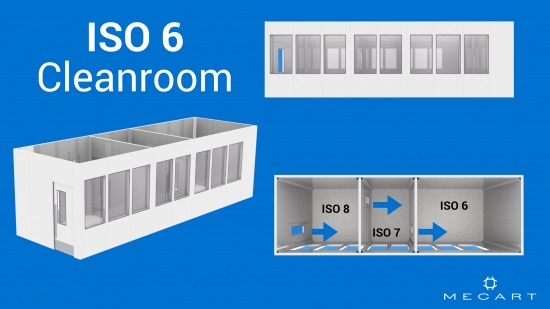
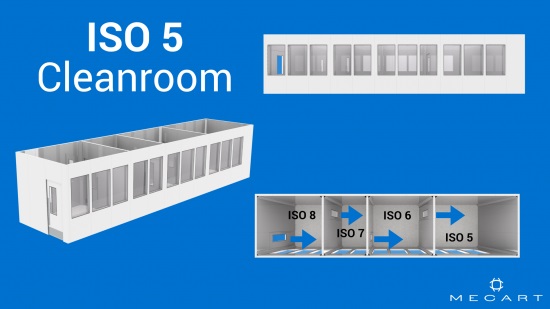
(ISO 8, ISO vii, ISO 6, ISO 5)
Clean Room Classifications
Clean rooms are classified according to the cleanliness level of the air inside the controlled environment. The make clean room course is the level of cleanliness the room complies with, according to the quantity and size of particles per cubic meters of air. The primary authority in the U.s. and Canada is the ISO nomenclature system ISO 14644-1.
This ISO standard includes these clean room classes : ISO 1, ISO 2, ISO iii, ISO 4, ISO five, ISO six, ISO 7, ISO 8 and ISO nine. ISO 1 is the "cleanest" form and ISO ix is the "dirtiest" course. Even if information technology's classified as the "dirtiest" form, the ISO 9 clean room surroundings is cleaner than a regular room.
The most common ISO make clean room classes are ISO 7 and ISO 8. The Federal Standard 209 ( FS 209E ) equivalent for these ISO classes are Course 10,000 and Class 100 000.
The erstwhile Federal Standard 209E ( FS 209E ) includes these clean room classes : Course 100,000; Class 10,000; Course i,000; Grade 100; Class 10; Grade 1. This standard was replaced in 1999 by ISO-14644-1. It was withdrawn in 2001, merely information technology is nevertheless widely used.
Clean rooms must likewise follow industry-specific and international standards. For example, Eu GMP (A-B-C-D), applies to pharmaceutical products and USP (795, 797 and 800) to compounding pharmacies.
Y'all might also like this article —>How Nomenclature Impacts your Cleanroom Design
Want to acquire more than most Make clean Rooms? —>What is a Clean room?
Request a quote
Download our PDF Cleanroom Brochure
| ISO 14644-i | FS 209E |
|---|---|
| ISO 3 | Course 1 |
| ISO 4 | Class 10 |
| ISO five | Class 100 |
| ISO 6 | Class 1,000 |
| ISO 7 | Course 10,000 |
| ISO 8 | Form 100,000 |
Clean room classification particle concentration
The basis of clean room standards is the micrometer, or micron for brusk (µm), which is the size of the particles to be filtered. As stated before, make clean rooms are classified by how clean the air is, co-ordinate to the number of particles and size of particles per volume of air. The clean room classification table below shows the maximum concentration limits (particles/m3 of air) for particles equal to and larger than the considered sizes shown.
Some classifications do not require certain particle sizes to be tested because the respective concentrations are too depression or too high to be tested, but they should non exist nix.
| ISO Class | Maximum Particles/g3 | Particles/ftiii | FS 209E Equivalent | |||||
|---|---|---|---|---|---|---|---|---|
| ≥0.1µm | ≥0.2µm | ≥0.3µm | ≥0.5µm | ≥1µm | ≥5µm | ≥0.5µm | ||
| ISO ane | 10 | |||||||
| ISO 2 | 100 | 24 | 10 | |||||
| ISO 3 | 1,000 | 237 | 102 | 35 | 1 | Class 1 | ||
| ISO 4 | x,000 | 2,370 | 1,020 | 352 | 83 | 10 | Class 10 | |
| ISO v | 100,000 | 23,700 | 10,200 | 3,520 | 832 | 29 | 100 | Form 100 |
| ISO 6 | 1,000,000 | 237,000 | 102,000 | 35,200 | 8,320 | 293 | 1,000 | Grade 1,000 |
| ISO seven | 352,000 | 83,200 | 2,930 | x,000 | Form 10,000 | |||
| ISO 8 | 3,520,000 | 832,000 | 29,300 | 100,000 | Class 100,000 | |||
| ISO 9 | 35,200,000 | viii,320,000 | 293,000 | |||||
** Old FS 209E classes were calculated in particles per cubic foot, whereas ISO classes are in cubic meter of air.
| ISO Class | Maximum Particles/grandthree | Particles/ftthree | FS 209E Equivalent | |||||
|---|---|---|---|---|---|---|---|---|
| ≥0.1µm | ≥0.2µm | ≥0.3µm | ≥0.5µm | ≥1µm | ≥5µm | ≥0.5µm | ||
| ISO 7 | 352,000 | 83,200 | 2,930 | 10,000 | Form 10,000 | |||
For ISO 7, particles smaller than 0.5 microns (≥0.ane µm, ≥0.2 µm, ≥0.3 µm) are not taken into consideration. The concentration of particles of ≥0.5 µm and to a higher place should be below 352,000, for particles of 1 micron and above 83,200 or lower and for particles of 5 microns and above two,930 or lower.
Cleanroom classification and air changes per 60 minutes
Air cleanliness is achieved past passing the air through HEPA filters using menstruum principles such as laminar catamenia. The more than often the air passes through the HEPA filters, the fewer particles are left in the room air. The volume of air filtered in one 60 minutes divided past the volume of the room gives the number of air changes per hour.
| ISO Form | Boilerplate number of air changes per hour |
|---|---|
| ISO five | 240–360 (unidirectional air catamenia) |
| ISO 6 | ninety–180 |
| ISO vii | 30–threescore |
| ISO 8 | 10–25 |
| Conventional building | two – 4 |
The above-suggested air changes per 60 minutes are only a design dominion of thumb. They should be computed past an HVAC clean room expert, as many aspects must be taken into consideration, such as the size of the room, the number of people in the room, the equipment in the room, the processes involved, the heat gain, etc.
Contact our experts to discuss your project
Disclaimer
This article will assistance you understand the bones differences between an ISO 5, ISO half-dozen, ISO 7 and ISO viii clean room every bit per ISO 14644. Please note that this data is only provided for educational purposes.
The definitions in this article are oversimplified in social club to assist with agreement. This article will not help you decide which clean room classification you lot must reach. If help is needed in this respect, seek the advice of an expert in your industry (pharmaceutical, medical devices, sterile compounding, electronics, etc.).
Turnkey Design-Build & Partnerships
We can Pattern-Build-Install and Commission your cleanroom or we can partner with other professionals that your are currently working with!
Contact Us
Source: https://www.mecart-cleanrooms.com/learning-center/cleanroom-classifications-iso-8-iso-7-iso-6-iso-5/#:~:text=The%20most%20common%20ISO%20clean,%3B%20Class%2010%3B%20Class%201.
0 Response to "What Iso Class Corresponds to Fed. Std. 209 Class 100 Cleanroom and Class 1, Respectively?"
Post a Comment